


Dating after divorce is often seen as returning to normal, or that life should reset once the legal process is over. The truth is, though, that when you are recovering emotionally, this doesn’t follow some kind of timeline. Healing can come slowly and quietly, and it sometimes means that people get a desire for connection.
Some people are curious about dating again while still feeling anger, grief, sadness, uncertainty, and other strong emotions. When this happens, it can make them feel like they are being irresponsible. Wanting a partner while healing shows how loss, attachment, and hope can work together in life.
If you have felt functional but you aren’t healed yet, or you are cautious but open, this article is for you. It won’t tell you that dating will fix all of your problems or heal your emotional pain, but it will show you how dating can work together with healing in a responsible and grounded way.
Healing After a Divorce
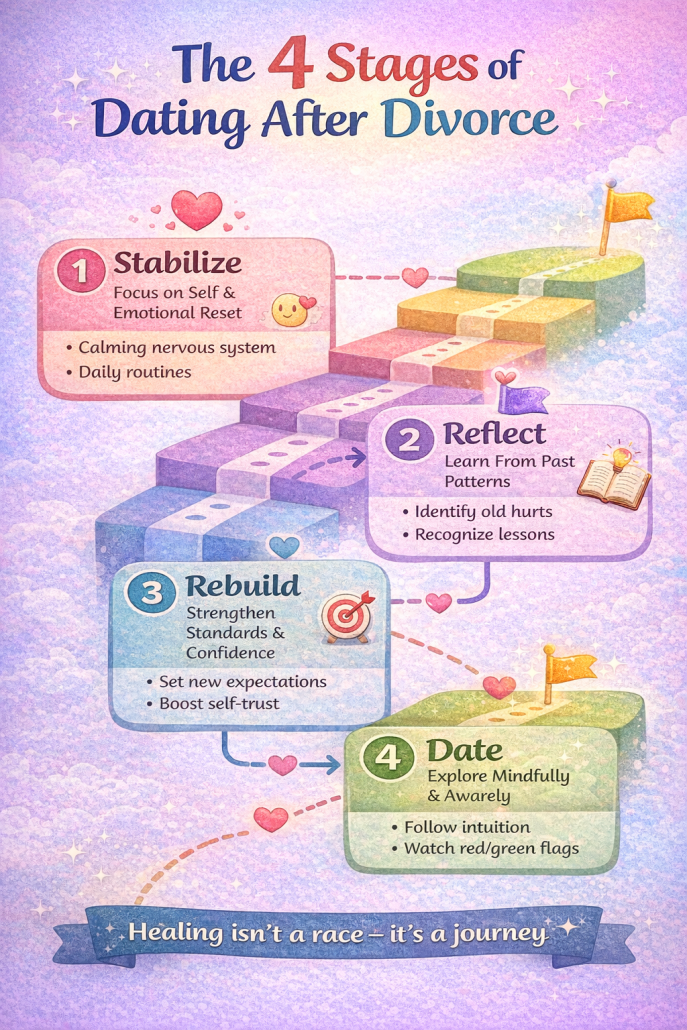
Healing after divorce is rarely a straight line. It doesn’t move neatly forward. Periods of calm are often followed by emotional waves brought on by memory, routine, or the start of new intimacy.
Psychologists have long noted that major relational losses can create delayed emotional responses. Research summarized by the American Psychological Association explains that grief often resurfaces well after the initial separation, especially when identity, attachment, and future expectations are involved.
Divorce changes more than a relationship status. It reshapes daily routines, social connections, finances, and how someone sees themselves. Many people function well on the surface, managing responsibilities and moving forward, while still feeling emotionally raw once dating begins. Intimacy brings emotional memory back online, not because healing hasn’t happened, but because the nervous system is still integrating loss.
Feeling Better Doesn’t Mean You’re Healed
Feeling better doesn’t mean healing is done. It usually means the sharpest pain has eased.
Sensitivity, sadness, or hesitation that stays doesn’t mean someone isn’t ready. Long relationships leave emotional traces that don’t vanish just because the relationship ends. Emotional maturity is about recognizing those traces without letting them run the show.
Waiting to feel completely confident or emotionally neutral before dating can quietly turn into avoidance. Healing continues through lived experience, reflection, and gentle vulnerability, not by waiting until nothing is felt at all.
Healing and Emotional Shutdown
Healing and emotional shutdown can look the same on the outside, but they are very different. Healing means having self-awareness, the way to regulate your discomfort, and emotional flexibility. When there is an emotional shutdown, it means you are detached, numb, or you have a hard time protecting yourself. One supports having healthy dating, and the other blocks it.
People who are healing might feel fear without letting it rule them. They might feel attraction without feeling rushed into dating. They set boundaries without withdrawing. Emotional shutdown, on the other hand, replaces your curiosity and makes you scared or indifferent.
Dating while healing doesn’t mean you have to be fearless, but it means you have to respond without abandoning who you are.
Signs You’re Ready to Date
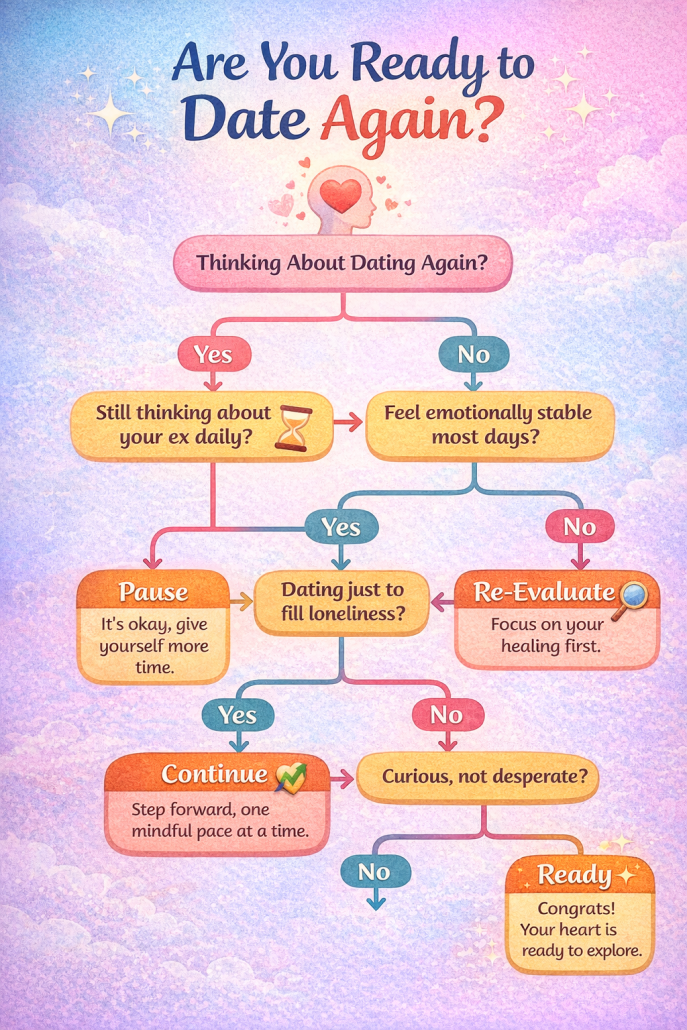
Being ready doesn’t mean that you are open to everything, and it doesn’t have to be about confidence. You might be ready to date if you are more curious than worried and if you are able to deal with disappointment instead of it controlling you. If the attention you’re getting feels good instead of necessary and your boundaries are clear instead of structured, then you need to trust what you need without going into self-doubt.
Healing is about being resilient instead of having to always be certain.
Dating Can Be Harmful When There Isn’t Emotional Readiness
Dating becomes harmful not because it happens “too soon,” but because it’s driven by avoidance instead of readiness.
After a divorce, loneliness can feel urgent. Attention can temporarily quiet grief, and that relief can feel stabilizing at first. But it often fades quickly. Rebound dynamics tend to bring intensity that feels grounding in the beginning and destabilizing over time.
A nervous system that’s still recalibrating often reaches for what feels familiar, not necessarily what’s healthy. This helps explain why people are sometimes drawn to emotionally unavailable or high-drama connections shortly after divorce. The pull isn’t random. It’s familiar.
If dating regularly leaves you feeling anxious, drained, or emotionally preoccupied, it may be a sign that more internal support is needed before continuing.
Understanding Dating Goals After Healing
Dating while healing calls for different goals than dating for a long-term partnership. The focus isn’t reassurance or completion. It’s awareness and self-trust. Recovery-focused dating values noticing how you feel over where things are going. Curiosity matters more than certainty.
Casual dating can be healthy when it’s honest. At this stage, clarity matters more than commitment. Simple statements like, “I’m dating thoughtfully right now,” or “I’m still finding my footing after divorce,” offer context without overexplaining.
When dating goals match emotional capacity, dating can support healing instead of pulling against it.
Attachment Patterns That Come with Divorce
Divorce can temporarily stop attachment systems even if people felt secure in the past. When someone doesn’t get an answered text message, it can trigger their anxiety. Emotional distance might feel personal, and these aren’t flaws in their character, but they are attachment systems that are responding to past pain.
According to the National Institute of Mental Health, it shows that when there are major stressors, it can increase emotional reactivity and sensitivity to the threat they are feeling.
Instead of labeling yourself in a certain way, notice patterns. Being aware can help to reduce reactivity more than looking at your own situation.
Emotional Boundaries and Healing
It’s important to have boundaries after you get a divorce to help protect your emotional energy without stopping yourself from being able to connect.
Having healthy boundaries separates one person’s behavior from their own worth. When someone shows disinterest in you, this is information, but not a final verdict. Boundaries also regulate disclosure, and your story deserves to go slow.
Learning to leave a relationship early when something doesn’t feel aligned doesn’t mean you’re failing. This shows that you are trusting yourself. Staying with someone because of hope or feeling obligated will just make uncertainty and emotional labor last longer.
Dating Isn’t Just Emotional
Dating isn’t just emotional, but it’s also physiological. After you get a divorce, your nervous system is more sensitive to closeness, rejection, and other cues. Physical reactions such as restlessness, fatigue, or tightness of the chest are common.
Trauma-informed research shows that relational loss can increase the fight, flight, freeze, or fawn responses that people have, and when you learn to recognize these patterns, it allows a place of regulation before the interpretation happens.
Using grounding techniques such as taking deep breaths, paying attention to physical sensations, or pausing before responding can help the nervous system to settle down. Dating gets clearer when the body is regulated enough to be able to participate the right way.
Fear and Intuition After Divorce
After going through a divorce, intuition might be less reliable, but it is louder. Fear sometimes sounds like intuition.
Fear can be urgent and can think of problems, demands you to take action immediately, and intuition is quieter and steadier, and it gives you information without forcing action or pressuring you.
Learning to know the difference takes time, patience, and practice. You can use reflective tools like meditation, journaling, or self-inquiry to help you to get to know your internal signals of clarity instead of anxiety.
Getting Spiritual Support While Dating
Divorce often disrupts a person’s sense of meaning and personal story. Reflective practices can help rebuild that sense of coherence after loss.
Symbolic tools like tarot or astrology are increasingly used not as a prediction, but as a reflection. They give people a way to externalize emotions, notice patterns, and make sense of experiences that feel confusing or layered. The value isn’t certainty. It’s perspective.
Real-World Dating Examples
Dating during recovery often looks different from what people expect.
Some enjoy going on dates without wanting immediate commitment. When communicated honestly, this isn’t misleading. Others notice they’re repeatedly drawn to emotionally unavailable partners, which often reflects unfinished attachment repair rather than poor judgment.
Some meet someone who is kind but emotionally incompatible. Choosing not to continue isn’t regression. It’s discernment. Others pause dating altogether to recalibrate. Pausing isn’t failure. It’s responsiveness.
Not Letting Divorce Define Who You Are
Divorce is part of your history, not your identity. Early disclosure tends to work best when it’s factual rather than emotionally loaded. Safe listeners show curiosity without pressure and respect boundaries without interpreting them as rejection.
Public attitudes toward divorce have shifted. Research from the Pew Research Center shows divorce is increasingly viewed as a common life transition rather than a personal failure. You aren’t an exception. You’re part of a broader social reality.
Healthy Progress
Healing is normally quiet. Dating is more about information and is less consuming, and you might be interested without being preoccupied. Calm interactions replace emotional instability.
Boredom might be a sign of safety and stability, which might not feel familiar at first, but that doesn’t mean it’s wrong. Progress can look like picking peace over potential and consistency over intensity.
Disappointment Is a Normal Thing
Disappointment is a normal thing, and emotional fatigue can add up. If you are dating and you feel constantly drained or you aren’t able to be yourself, take time to pause. Pausing doesn’t mean you’re failing at dating; it just means you’re listening to your own needs.
Progress isn’t based on relationship status, but it’s about self-trust.
Final Thoughts: Dating After Divorce Doesn’t Mean Perfection
Dating after divorce doesn’t mean you have to isolate yourself or be perfect in your emotions. It means that you need to be honest, take time, and be aware of what you want and need.
Healing doesn’t mean that you replace what you lost, but it’s about learning how you want to show up now, in the present. When dating is about self-trust, it becomes part of the recovery instead of a detour from it.
Frequently Asked Questions
1. Is it okay to date after a divorce if you are still healing?
Yes. You do not need to be perfectly healed to start dating again. The healthier question is whether you can date with honesty, self-awareness, and emotional responsibility instead of using dating to avoid pain.
2. How do I know if I am ready to date after a divorce?
You may be ready if you feel more curious than desperate, can handle disappointment without spiraling, and can keep your boundaries without doubting your worth. Readiness is more about resilience than complete emotional certainty.
3. Does feeling better mean I am fully healed?
No. Feeling better usually means the sharpest part of the pain has eased. You can still carry emotional sensitivity, grief, or hesitation while making healthy choices in dating.
4. What is the difference between healing and emotional shutdown?
Healing includes self-awareness, emotional flexibility, and the ability to stay connected to yourself even when dating feels uncomfortable. Emotional shutdown is more about numbness, detachment, or avoiding vulnerability altogether.
5. Can dating help healing after divorce?
It can, when approached in a grounded way. Dating can help you notice patterns, rebuild self-trust, and practice boundaries, but it should support healing rather than replace it.
6. When is dating after divorce most likely to become harmful?
Dating tends to become harmful when it is driven by avoidance, loneliness, or the need for reassurance rather than genuine readiness. In those cases, attention may briefly soothe the pain but often leaves you feeling more unsettled later.
7. Is there a set timeline for when I should date after divorce?
No. Healing after divorce is rarely linear, and there is no universal timetable. Some people need more time, while others are open to dating sooner in a thoughtful and emotionally aware way.
8. What are rebound dynamics after divorce?
Rebound dynamics usually involve intense connection that feels stabilizing at first but becomes emotionally confusing or draining over time. This often happens when dating is used to numb grief rather than process it.
9. Why am I drawn to emotionally unavailable people after divorce?
After divorce, your nervous system may reach for what feels familiar instead of what is truly healthy. That can make emotionally unavailable or high-drama people feel strangely compelling even when they are not good for you.
10. What should my dating goals be while I am still healing?
Your goals may need to be softer and more realistic. Instead of looking for immediate certainty or commitment, focus on awareness, honesty, self-trust, and noticing how dating experiences affect you emotionally.
11. Can casual dating be healthy after divorce?
Yes, casual dating can be healthy if it is honest and matches your emotional capacity. Clarity matters more than labels, and simple communication about where you are emotionally can prevent confusion.
12. How does divorce affect attachment patterns?
Divorce can temporarily intensify attachment responses, even in people who once felt secure. Delayed texts, mixed signals, or emotional distance can feel more threatening because past pain is still active in the system.
13. Why are emotional boundaries so important after divorce?
Boundaries protect your emotional energy without closing you off from connection. They help you separate someone else’s interest or behavior from your self-worth and allow your story to unfold at a pace that feels safe.
14. What are physical signs that dating is affecting my nervous system?
You might notice restlessness, chest tightness, fatigue, overthinking, or a sense of emotional overload. These reactions can be signs that your body still needs more regulation and support.
15. How can I tell the difference between fear and intuition after divorce?
Fear usually feels urgent, loud, and pressuring. Intuition is quieter, steadier, and more informative. Learning the difference often takes time, journaling, reflection, and honest self-observation.
16. Can spiritual tools help while dating after divorce?
For many people, yes. Reflective practices like journaling, meditation, tarot, or astrology can help them notice patterns, clarify emotions, and rebuild a sense of personal meaning after loss.
17. Is it a bad sign if I pause dating again?
No. Pausing is not failure. It can be a healthy response when dating feels draining, confusing, or emotionally ungrounded. Sometimes stopping is how you protect your progress.
18. How should I talk about my divorce with someone new?
It often helps to keep early disclosure simple, factual, and not emotionally overloaded. You do not need to explain everything at once. Safe people will respect your pace and your boundaries.
19. What does healthy progress look like when dating after divorce?
Healthy progress often feels quieter than people expect. You may feel interested without becoming consumed, prefer consistency over intensity, and choose peace over emotional chaos.
20. What is the biggest mindset shift for dating after divorce?
The biggest shift is realizing that dating is not a test of whether you are fully healed. It is a chance to practice self-trust, honesty, and emotional awareness while learning how you want to show up now.