

There is no universal waiting period after a breakup. Readiness is less about the number of weeks or months that have passed and more about what your inner life looks like now. You can still remember your former relationship, miss parts of it, or feel cautious and still be ready to meet someone new. The key question is whether dating feels like a choice rather than an emergency escape from loneliness or pain.
Emotional Readiness Matters More Than a Deadline
Dating too quickly can make it easy to compare every new person with an ex, overlook incompatibility, or seek reassurance instead of connection. Waiting forever is not the answer either. A more useful approach is to look for signs of stability, self-awareness, and willingness to build trust gradually.
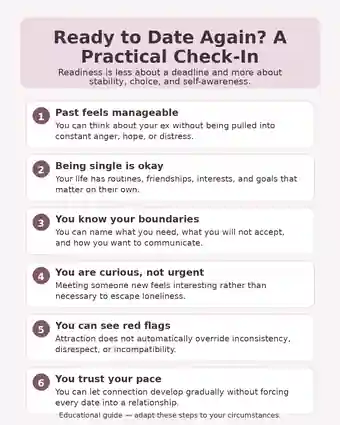
1. You Can Think About the Breakup Without Being Overwhelmed
The relationship can still matter without controlling your day. Anger, sadness, hope, or resentment may still appear, but they are not constantly pulling you back into the past.
2. You Feel Comfortable Being Single
You have begun rebuilding a life that works without romantic attention. Friendships, interests, routines, work, and personal goals have value even when nobody is texting you good morning.
3. You No Longer Compare Everyone With Your Ex
New people are allowed to be themselves. You notice their qualities and compatibility instead of grading them against a former partner.
4. You Know What You Want More Clearly
You can name important values, relationship goals, communication preferences, and deal breakers. Chemistry still matters, but it is no longer the only filter.
5. You Are Willing to Be Emotionally Open Again
Readiness does not mean trusting instantly. It means fear is no longer making every decision for you. You can share gradually, ask questions, and allow closeness to develop.
6. Your Boundaries Are Stronger
You know how to say no, ask for clarity, protect your time, and leave situations that repeatedly feel disrespectful. Strong healthy relationship boundaries make dating safer and clearer.
7. Meeting New People Feels Interesting
Curiosity is replacing desperation. You can enjoy a conversation or date even if it does not become a relationship.
8. You Trust Your Judgment More
You are more willing to notice inconsistency, ask direct questions, and listen when something does not feel right. Self-trust does not make you infallible; it makes you more willing to respond to what you observe.
9. You Are Not Dating for Constant Validation
A match, compliment, or text can feel good without deciding your worth for the day. You can tolerate normal gaps in communication without immediately assuming rejection.
10. People Close to You Notice More Stability
Trusted friends may see that you are calmer, more engaged, or less consumed by the old relationship. Their observations are not a verdict, but they can offer perspective.
11. You Can Reflect on Your Own Patterns
You can look at communication habits, conflict, attachment, or choices without turning reflection into shame. The goal is to learn what you want to do differently next time.
12. You Still Believe Healthy Love Is Possible
Hope has returned in a realistic form. You are not expecting perfection, but you believe a respectful, compatible relationship can exist.
13. You Are No Longer Monitoring Your Ex
You do not feel compelled to check their social media, ask mutual friends for updates, or interpret every post as a message about you.
14. Your Daily Life Has Structure Again
Sleep, work, exercise, friendships, hobbies, and responsibilities no longer feel completely organized around the breakup.
15. Dating Feels Calm Rather Than Urgent
You can let compatibility unfold over time. A first date does not need to become a relationship, and attraction does not need to be converted into certainty.
What to Avoid When You Start Dating Again
Move at a pace that gives you time to observe consistency. Do not ignore red flags because being alone feels uncomfortable. Avoid using a new relationship to provoke an ex, prove you are desirable, or avoid unresolved grief. If you want spiritual relationship guidance, treat it as reflection rather than certainty about another person’s feelings or future behavior.
Final Thoughts
Being ready to date again does not mean being perfectly healed. It means you have enough stability and self-awareness to meet another person as they are, keep your boundaries, and make choices without asking a new relationship to repair your self-worth.
Frequently Asked Questions
1. How long should I wait to date after a breakup?
There is no fixed timeline. Readiness depends more on emotional stability, self-awareness, and your reasons for dating than on a specific number of days or months.
2. Can I still miss my ex and be ready to date?
Yes. Missing someone does not automatically mean you are unready if the past relationship no longer controls your choices.
3. What is the clearest sign I am ready to date again?
A strong sign is that dating feels like a calm choice to connect rather than an urgent attempt to escape loneliness.
4. Should I date if I still check my ex’s social media?
Occasional curiosity is different from compulsive monitoring. If checking keeps you emotionally stuck, more distance may help before dating seriously.
5. Is loneliness a good reason to start dating?
Loneliness is human, but dating mainly to remove loneliness can make it harder to assess compatibility clearly.
6. How do I know if I am using dating for validation?
Notice whether your mood and self-worth rise or fall sharply based on matches, texts, compliments, or attention.
7. Can a rebound relationship become healthy?
It can, but the label matters less than whether both people are emotionally available, honest about intentions, and able to build trust gradually.
8. Should I tell a new date about my breakup?
You can share relevant context without turning the new person into a therapist or making the previous relationship the center of every conversation.
9. How soon is too soon to become exclusive?
There is no universal deadline. Give yourself enough time to observe consistency, communication, values, and how the person handles boundaries.
10. What if every date reminds me of my ex?
That may mean the old relationship is still taking up substantial emotional space. Slowing down can give you time to reset.
11. How can I avoid repeating old patterns?
Identify the patterns you want to change, define boundaries before dating, and pay attention to behavior rather than only chemistry.
12. What boundaries matter most when dating again?
Useful boundaries can cover communication, pace, physical intimacy, exclusivity, privacy, time, and how conflict is handled.
13. Is being nervous a sign I am not ready?
No. Some nervousness is normal. Readiness means you can tolerate uncertainty without abandoning your values or boundaries.
14. Can therapy help before dating again?
Yes. A qualified therapist can help if the breakup involved trauma, repeated unhealthy patterns, severe distress, or difficulty trusting yourself.
15. Should friends decide when I am ready?
No. Trusted people can offer perspective, but the decision should reflect your own stability, goals, and circumstances.
16. How do I stop comparing new people with my ex?
Focus on the individual in front of you and evaluate compatibility using your current values rather than a former partner as the benchmark.
17. What if I want my ex back while dating other people?
If reconciliation remains your primary goal, dating others can create confusion for you and for new partners. Clarifying your intention first may be kinder.
18. Does feeling attracted to someone mean I am ready?
Attraction is only one part of readiness. Emotional availability, boundaries, self-trust, and realistic expectations also matter.
19. Can psychic guidance tell me if I should date someone?
Psychic guidance can be used for personal reflection, but it cannot reliably establish another person’s intentions, compatibility, consent, or future behavior.
20. What is a healthy first goal when dating again?
Aim to learn about the other person and how you feel around them, rather than deciding immediately whether they are your next long-term partner.