


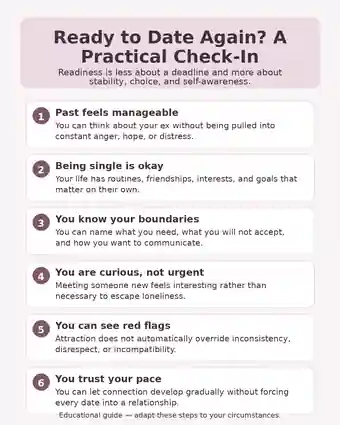
Deciding whether to date after a breakup can feel harder than arranging the date itself. You may want company and still miss your ex. You may feel hopeful in the morning and uncertain that evening. Instead of waiting for a particular feeling to prove you are ready, consider what you can choose, communicate and change now.
The 15 signs below are prompts for reflection. They are not a test, and you do not need to tick every box. A quiet feeling does not certify that someone is safe, and nervousness does not automatically rule out dating. You can try a small step, wait or change your mind.
Start with the decision in front of you
“Am I ready for another relationship?” can bundle together several different decisions. Browsing profiles, accepting an introduction, going on one date and agreeing to exclusivity each ask something different of you. Name the step you are considering before judging whether you have room for it.
For example, you might be open to a conversation while unsure about a relationship. You can say that plainly. The other person can decide whether your current intentions fit theirs.
1. You can say what you want to try
Give the next step a purpose you can explain: meeting someone interesting, exploring attraction or looking for a long-term partner. Wanting companionship is a valid wish. Notice whether you are also expecting a new person to make an ex jealous or settle a question about your worth.
Try this: Complete “I would like to ___, and I am not currently offering ___.” Your answer can be provisional; communicate a change if one happens.
2. One date can remain one date
You can want a date to go well without treating a second invitation as its only worthwhile outcome. There may be mutual interest, different preferences or no wish to meet again. None of those answers provides a complete assessment of you.
Try this: Plan something ordinary to return to afterward. Let the date be one part of your day rather than the event on which everything depends.
3. You can share relevant context without telling the whole story
A new person may need to know that you recently separated, that your availability is limited or that you want to move slowly. They do not need every private detail of the former relationship. You can be honest while keeping parts of your history private.
Try this: Prepare a sentence such as “A relationship ended recently, and I am taking dating slowly.” If more explanation feels uncomfortable, say what you are willing to discuss now.
4. Memories can be memories rather than instructions
A place, song or conversation may remind you of your ex. That does not automatically mean you should reconnect, cancel a date or pursue someone new. Ask what you actually know about the current situation before choosing what to do.
Try this: Separate “This reminded me of the past” from “This person has done something concerning.” If there is a current concern, take it seriously on its own facts.
5. Your calendar has room for the step you are considering
Readiness also has a practical side. Work, caring responsibilities, rest, travel and other commitments affect what you can offer. A full calendar does not make you incapable of connection; it may mean a smaller plan fits better than frequent dates.
Try this: Look at an actual week. Choose a time that does not depend on repeatedly dropping important commitments, and be clear about your availability.
6. Support can come from more than a romantic prospect
It is reasonable to want kindness and reassurance. Consider who else you can turn to when you need company or help thinking something through. A friend, family member, community or professional support may each have a place, depending on your needs.
Try this: Name one person or activity you can contact or return to if a date disappoints you. A new partner does not have to become your only source of support.
7. You can choose a pace before you feel pressured
You can enjoy attention and still prefer fewer messages, shorter meetings or more time before another commitment. You do not have to copy the pace of your last relationship or match somebody else’s enthusiasm by agreeing to more than you want.
Try this: Turn “I want to take it slowly” into something concrete: “I would like to meet once this week and decide afterward about another date.”
8. You can name a boundary and keep the right to change it
Consider time, privacy, physical contact and what you share online. Agreement in one area does not imply agreement in another. You can be interested in someone and decline a request.
The love is respect guide to personal boundaries explains emotional, physical and digital limits, including the difference between protecting a limit and controlling another person.
Try this: Practice one clear answer: “I would like to keep that private,” “I am not ready for that,” or “I would prefer to meet somewhere else.”
9. You can hear another person’s answer
Someone may want friendship, a different kind of relationship or no further contact. Disappointment can hurt without becoming a reason to negotiate past a refusal. The same respect applies when you are the person saying no.
Try this: Think about how you would end an invitation kindly and clearly. “Thank you for telling me” can be enough when someone declines.
10. Necessary contact with an ex has a practical place
Some people continue contact about children, a shared home, belongings or other responsibilities. Having that contact does not by itself answer whether you should date. Consider what is settled, what still needs attention and what information affects a new person’s choices.
Try this: Distinguish necessary arrangements from attempts to reopen the relationship. Keep new dating plans separate from efforts to provoke a response from an ex.
11. An urge to check on your ex leaves room for another choice
You may still feel curious about an ex’s life. Consider what checking their social accounts or asking for updates does for you afterward. You can experiment with changing a habit without making a rule that you must never think about them.
Try this: If checking regularly leaves you upset, mute an account, stop requesting updates or choose another activity when the urge appears. Review whether that change helps you.
12. You can describe a past pattern in concrete terms
“I always choose the wrong people” is difficult to act on. “I agree to exclusivity before we have talked about what it means” points to a question you can ask earlier. Reflection can focus on your available choices without making you responsible for another person’s harmful behavior.
Try this: Use the guide to examining repeated dating patterns to identify one behavior, context or response you want to approach differently.
13. You can compare a plan with what matters to you
Attraction does not settle availability, relationship preferences or everyday compatibility. Ask about things that affect your decision instead of assuming that strong chemistry supplies an answer.
Try this: Choose one current priority, such as how often you want to meet or whether you want exclusivity. Ask about it, listen and consider whether the answers fit.
14. You can ask for clarification instead of filling every gap
A delayed reply may have several explanations. You do not need to diagnose the person or decide immediately that the past is repeating. Equally, you can respond to repeated behavior that does not work for you.
Try this: Ask a practical question: “What sort of contact works for you between dates?” The guide to making relationship requests specific offers examples of turning a broad wish into a conversation.
15. You can reconsider after you learn something
Agreeing to a date does not commit you to a relationship. You may want to meet again, change the pace or stop. A useful next step leaves room for that information rather than requiring you to prove that your original decision was correct.
Try this: Afterward, ask “What did I enjoy?”, “What did I learn?” and “What do I want to offer next?” Your answer may differ from the other person’s.
A small plan you can change
In this hypothetical example, Alex is curious about dating but has limited free time after a breakup. Alex tells Jamie that they would enjoy meeting for coffee and are unsure about a serious relationship. Jamie says they are looking for a committed partner and do not want to meet on those terms. Alex feels disappointed, thanks Jamie for being clear and makes other plans. The conversation supplied useful information; neither person needed to be wrong.
Before making your own plan, write down the step you want to try, what you can currently offer and what would make you want to slow down or stop. You do not need a deadline for finding another partner.
When waiting or getting support may fit better
You can pause because you do not want to date, because practical demands take priority or because the experience is adding more difficulty than you want to manage. You do not owe anyone a trial date. If distress is making everyday life difficult, consider talking with a qualified professional about the support you need.
If you are dealing with threats, stalking, pressure or fear about a former partner, focus on your immediate situation and support rather than using this list to decide whether you are ready. A private safety plan may be more useful than discussing new dating with that person.
Spiritual reflection can help you put wishes and questions into words if it fits your beliefs. A reading, dream or sign cannot establish a new person’s intentions, consent or future behavior. Keep the next decision tied to the information and choices actually available.
Frequently asked questions
1. How long should I wait to date after a breakup?
There is no date on the calendar that makes the decision for everyone. Consider the particular step you want to try, what you can currently offer and whether you want to make room for it. You can also choose to wait.
2. Do I have to stop missing my ex before I date?
Missing someone does not decide your next step by itself. Consider whether you can pay attention to a new person, communicate your intentions and respect both people’s choices without using the date to provoke or replace your ex.
3. Does being nervous mean I am not ready?
Nervousness alone does not settle the decision. You can choose a smaller plan, ask questions or wait. If distress is making everyday life difficult, consider qualified support rather than treating a readiness list as an assessment.
4. What should I tell a new date about my breakup?
Share context that affects what you can offer, such as wanting to move slowly or having limited availability. You can keep private details private and say when you are not ready to discuss more.
5. Can I date if I still have necessary contact with my ex?
Necessary contact about children, belongings or shared responsibilities does not automatically rule out dating. Consider what remains unsettled and communicate relevant circumstances honestly, while keeping new dating separate from attempts to influence your ex.
6. What if I want companionship but not a serious relationship?
Say what you are currently seeking before making assumptions about a shared future. The other person may want something different and can decline. Update them if your intentions change.
7. Can a psychic reading tell me whether I am ready?
A reading may provide questions for personal reflection if that fits your beliefs. It cannot establish another person’s consent, intentions or future behavior. Make the next decision using your circumstances, available information and choices.
8. Can I pause after I have started dating?
Yes. Agreeing to one date does not commit you to another date or a relationship. You can change the pace or stop, and communicate that decision clearly without needing to prove you made a mistake by trying.